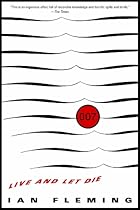
''Live and Let Die is one of Ian Fleming's best plots, hard-hitting and violent in a way that none of the others are. The writing displays the author's confident ability to sweep the reader along at a breakneck pace with an engaging rhythm and flow.'' --Raymond Benson, author of High Time to KillAbout the AuthorIan Fleming was born in London on May 28, 1908. He was educated at Eton College and later spent a formative period studying languages in Europe. His first job was with Reuters News Agency where a Moscow posting gave him firsthand experience with what would become his literary bete noirethe Soviet Union. During World War II he served as Assistant to the Director of Naval Intelligence and played a key role in Allied espionage operations. After the war he worked as foreign manager of the Sunday Times, a job that allowed him to spend two months each year in Jamaica. Here, in 1952, at his home Goldeneye, he wrote a book called Casino Royaleand James Bond was born. The first print run sold out within a month. For the next twelve years Fleming produced a novel a year featuring Special Agent 007, the most famous spy of the century. His travels, interests, and wartime experience lent authority to everything he wrote. Raymond Chandler described him as the most forceful and driving writer of thrillers in England. Sales soared when President Kennedy named the fifth title, From Russia With Love, one of his favorite books. The Bond novels have sold more than one hundred million copies worldwide, boosted by the hugely successful film franchise that began in 1962 with the release of Dr. No. He married Anne Rothermere in 1952. His story about a magical car, written in 1961 for their only son Caspar, went on to become the well- loved novel and film Chitty Chitty Bang Bang. Fleming died of heart failure on August 12, 1964, at the age of fifty-six.Excerpt. Reprinted by permission. All rights reserved.1. THE RED CARPET There are moments of great luxury in the life of a secret agent. There are assignments on which he is required to act the part of a very rich man; occasions when he takes refuge in good living to efface the memory of danger and the shadow of death; and times when, as was now the case, he is a guest in the territory of an allied Secret Service. From the moment the BOAC Stratocruiser taxied up to the International Air Terminal at Idlewild, James Bond was treated like royalty. When he left the aircraft with the other passengers he had resigned himself to the notorious purgatory of the US Health, Immigration and Customs machinery. At least an hour, he thought, of overheated, drab-green rooms smelling of last year's air and stale sweat and guilt and the fear that hangs round all frontiers, fear of those closed doors marked PRIVATE that hide the careful men, the files, the teleprinters chattering urgently to Washington, to the Bureau of Narcotics, Counter Espionage, the Treasury, the FBI. As he walked across the tarmac in the bitter January wind he saw his own name going over the network: BOND, JAMES. BRITISH DIPLOMATIC PASSPORT 0094567, the short wait and the replies coming back on the different machines: NEGATIVE, NEGATIVE, NEGATIVE. And then, from the FBI: POSITIVE AWAIT CHECK. There would be some hasty traffic on the FBI circuit with the Central Intelligence Agency and then: FBI TO IDLEWILD: BOND OKAY OKAY, and the bland official out front would hand him back his passport with a 'Hope you enjoy your stay, Mr Bond.' Bond shrugged his shoulders and followed the other passengers through the wire fence towards the door marked US HEALTH SERVICE. In his case it was only a boring routine, of course, but he disliked the idea of his dossier being in the possession of any foreign power. Anonymity was the chief tool of his trade. Every thread of his real identity that went on record in any file diminished his value and, ultimately, was a threat to his life. Here in America, where they knew all about him, he felt like a negro whose shadow has been stolen by the witch-doctor. A vital part of himself was in pawn, in the hands of others. Friends, of course, in this instance, but still . . . 'Mr Bond?' A pleasant-looking nondescript man in plain clothes had stepped forward from the shadow of the Health Service building. 'My name's Halloran. Pleased to meet you!' They shook hands. 'Hope you had a pleasant trip. Would you follow me, please?' He turned to the officer of the Airport police on guard at the door. 'Okay, Sergeant.' 'Okay, Mr Halloran. Be seeing you.' The other passengers had passed inside. Halloran turned to the left, away from the building. Another policeman held open a small gate in the high boundary fence. 'Bye, Mr Halloran.' Bye, Officer. Thanks.' Directly outside a black Buick waited, its engine sighing quietly. They climbed in. Bond's two light suitcases were in front next to the driver. Bond couldn't imagine how they had been extracted so quickly from the mound of passengers' luggage he had seen only minutes before being trolleyed over to Customs. 'Okay, Grady. Let's go.' Bond sank back luxuriously as the big limousine surged forward, slipping quickly into top through the Dynaflow gears. He turned to Halloran. 'Well, that's certainly one of the reddest carpets I've ever seen. I expected to be at least an hour getting through Immigration. Who laid it on? I'm not used to VIP treatment. Anyway, thanks very much for your part in it all.' 'You're very welcome, Mr Bond.' Halloran smiled and offered him a cigarette from a fresh pack of Luckies. 'We want to make your stay comfortable. Anything you want, just say so and it's yours. You've got some good friends in Washington. I don't myself know why you're here but it seems the authorities are keen that you should be a privileged guest of the Government. It's my job to see you get to your hotel as quickly and as comfortably as possible and then I'll hand over and be on my way. May I have your passport a moment, please.' Bond gave it to him. Halloran opened a briefcase on the seat beside him and took out a heavy metal stamp. He turned the pages of Bond's passport until he came to the US Visa, stamped it, scribbled his signature over the dark blue circle of the Department of Justice cypher and gave it back to him. Then he took out his pocket-book and extracted a thick white envelope which he gave to Bond. 'There's a thousand dollars in there, Mr Bond.' He held up his hand as Bond started to speak. 'And it's Communist money we took in the Schmidt-Kinaski haul. We're using it back at them and you are asked to co-operate and spend this in any way you like on your present assignment. I am advised that it will be considered a very unfriendly act if you refuse. Let's please say no more about it and,' he added, as Bond continued to hold the envelope dubiously in his hand, 'I am also to say that the disposal of this money through your hands has the knowledge and approval of your own Chief.' Bond eyed him narrowly and then grinned. He put the envelope away in his notecase. 'All right,' he said. 'And thanks. I'll try and spend it where it does most harm. I'm glad to have some working capital. It's certainly good to know it's been provided by the opposition.' 'Fine,' said Halloran; 'and now, if you'll forgive me, I'll just write up my notes for the report I'll have to put in. Have to remember to get a letter of thanks sent to Immigration and Customs and so forth for their co-operation. Routine.' 'Go ahead,' said Bond. He was glad to keep silent and gaze out at his first sight of America since the war. It was no waste of time to start picking up the American idiom again: the advertisements, the new car models and the prices of second-hand ones in the used-car lots; the exotic pungency of the road signs: SOFT SHOULDERS - SHARP CURVES - SQUEEZE AHEAD - SLIPPERY WHEN WET; the standard of driving; the number of women at the wheel, their menfolk docilely beside them; the men's clothes; the way the women were doing their hair; the Civil Defence warnings: IN CASE OF ENEMY ATTACK - KEEP MOVING - GET OFF BRIDGE; the thick rash of television aerials and the impact of TV on hoardings and shop windows; the occasional helicopter; the public appeals for cancer and polio funds: THE MARCH OF DIMES - all the small, fleeting impressions that were as important to his trade as are broken bark and bent twigs to the trapper in the jungle. The driver chose the Triborough Bridge and they soared across the breath-taking span into the heart of uptown Manhattan, the beautiful prospect of New York hastening towards them until they were down amongst the hooting, teeming, petrol-smelling roots of the stressed-concrete jungle. Bond turned to his companion. 'I hate to say it,' he said, 'but this must be the fattest atomic-bomb target on the whole face of the globe.' 'Nothing to touch it,' agreed Halloran. 'Keeps me awake nights thinking what would happen.' They drew up at the best hotel in New York, the St Regis, at the corner of Fifth Avenue and 55th Street. A saturnine middle-aged man in a dark blue overcoat and black homburg came forward behind the commissionaire. On the sidewalk, Halloran introduced him. 'Mr Bond, meet Captain Dexter.' He was deferential. 'Can I pass him along to you now, Captain?' 'Sure, sure. Just have his bags sent up. Room 2100. Top floor. I'll go ahead with Mr Bond and see he has everything he wants.' Bond turned to say good-bye to Halloran and thank him. For a moment Halloran had his back to him as he said something about Bond's luggage to the commissionaire. Bond looked past him across 55th Street. His eyes narrowed. A black sedan, a Chevrolet, was pulling sharply out into the thick traffic, right in front of a Checker cab that braked hard, its driver banging his fist down on the horn and holding it there. The sedan kept going, just caught the tail of the green light, and disappeared north up Fifth Avenue. It was a smart, decisive bit of driving, but what startled Bond was that it had been a negress at the wheel, a fine-looking negress in a black chauffeur's uniform, and through the rear window he had caught a glimpse of the single passenger - a huge grey-black face which had turned slowly towards him and looked directly back at him, Bond was sure of it, as the car accelerated towards the Avenue. Bond shook Halloran by the hand. Dexter touched his elbow impatiently. 'We'll go straight in and through the lobby to the elevators. Half-right across the lobby. And would you please keep your hat on, Mr Bond.' As Bond followed Dexter up the steps into the hotel he reflected that it was almost certainly too late for these precautions. Hardly anywhere in the world will you find a negress driving a car. A negress acting as a chauffeur is still more extraordinary. Barely conceivable even in Harlem, but that was certainly where the car was from. And the giant shape in the back seat? That grey-black face? Mister Big? 'Hm,' said Bond to himself as he followed the slim back of Captain Dexter into the elevator. The elevator slowed up for the twenty-first floor. 'We've got a little surprise ready for you, Mr Bond,' said Captain Dexter, without, Bond thought, much enthusiasm. They walked down the corridor to the corner room. The wind sighed outside the passage windows and Bond had a fleeting view of the tops of other skyscrapers and, beyond, the stark fingers of the trees in Central Park. He felt far out of touch with the ground and for a moment a strange feeling of loneliness and empty space gripped his heart. Dexter unlocked the door of No. 2100 and shut it behind them. They were in a small lighted lobby. They left their hats and coats on a chair and Dexter opened the door in front of... where can i download free pdf books quora Live and Let Die (James Bond)
0 of 0 people found the following review helpful. failed!!! What did I just buy?!?!? Live And Let Die (Spanish Edition)By J.G.What did I just buy?!?!? Sometimes is too big for it's own good. Here I am trying to buy a book and somehow I ended up with a bizzare edition of a classic spy novel. It is called "Live And Let Die (Spanish Edition)", yet it's an e-book in English. Also it seem to be an extremely edited version and not the original (some words changed either due to translation or political correctness ?).the worst part of it is is TOO LAZY to even put in a decent description. The only good thing is it was only 99 cents, but on the other hand it's 99 cents into the trash.Buying ebooks on ... ! should not be such a confusing task,1 of 1 people found the following review helpful. The disappointing Live and Let Die is a let down after Casino RoyaleBy Gary HoggattIan Fleming's Live and Let Die, published in 1954, is the second James Bond novel, following up Casino Royale. This volume features more action than the more cerebral Casino Royale, but it seems a little flat and unfocused to me.The premise of Live and Let Die (and this is all in the first chapter, so no spoilers here) is that James Bond is sent to New York to work with American intelligence to investigate the Haitian-American Harlem crime lord Mr. Big, who uses voodoo traditions in running his organization, and is secretly working for the Soviets by smuggling gold coins from the famous pirate Henry Morgan's long lost treasure in Jamaica to fund anti-American activities.Yes, I'm serious.It's an outlandish plot, even for a Bond story, but it somehow fails to really be as interesting as it sounds. Bond and CIA agent Felix Leiter poke around Harlem and find trouble, then head to Florida and find trouble, and finally Bond goes to Jamaica and learns to scuba dive. There's also a girl to rescue.Mr. Big is depicted as a villain who has always covered all his bases and has been untouchable. Bond defies Mr. Big in New York and Florida, but despite that, when Mr. Big captures Bond in Jamaica, he doesn't give any thought to what Bond was doing before being captured. Instead, he keeps Bond prisoner before putting into motion a needlessly complex death trap for the spy. There are even sharks involved (though, sadly, none with frickin' lasers on their heads). All this, of course, leads to Mr. Big's downfall and Bond's escape.Being written in the 1950's and heavily featuring the African-American community, the book is heavily dated (to put it gently) on that front. If that sort of thing bothers you, I'd avoid Live and Let Die.I listened to the novel as read by Simon Vance (who also performed Casino Royale under the name Robert Whitfield), and he was as good as ever. He's very effective as Bond, and does well portraying the rest of the cast.Live and Let Die just doesn't match up to Casino Royale, and manages to be both over the top and dull at the same time, while mixing in dated outlooks. I just can't recommend it like I could Casino Royale. It's not really bad, but it's also not particularly good, either.0 of 0 people found the following review helpful. "He disagreed with something that ate him"By JackOne of the many iconic lines from a masterful author. Sadly most now aren't familiar with this series except from the James Bond movies, which often had only the title in common with the book. The Bond character of the books, while quite ruthless, nevertheless suffered from normal human sensitivities that were rarely shown in the movies, making him a very interesting protagonist. This coupled with the amazing world of Mr. Big and Bond's struggles to bring his empire down make for a great read.