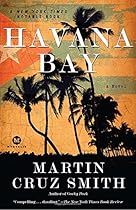
.com In this fourth book in Martin Cruz Smith's splendid series, an amiable Irish American gangster explains to Arkady Renko what he and the other 84 wanted Americans hiding out in Cuba do with themselves. "We try to stay alive. Useful. Tell me, Arkady, what are you doing here?" "The same," says Renko--and it's true. His life as a Russian cop has become so bleak and lonely that he takes any opportunity to shake things up, even spending his own savings to fly to Havana when an old colleague is found dead--floating inside an inner tube after night-fishing in Havana Bay. Renko sets out to make himself useful in this shabby, fascinating, haunted country whose inhabitants look on Russians with the cold disdain of survivors of a nasty divorce. As he did so well in Gorky Park, Smith again makes Renko very much a classic Russian hero in temperament and tradition, but also the eternal outsider. He is at times close to the edge of despair--but his trip to Havana restores his natural curiosity and life force. In this hot Havana, ripe with the fruity smell of sex, Renko keeps his Moscow overcoat on--until an equally idealistic and out-of-place young female cop gets him to loosen up. There's an unusually complex plot, even for the sly strand-spinner Smith. He raises baffling questions: Why would a group of military plotters order illegal lobsters in a fancy restaurant and then not eat them? And his descriptions of Cuban life are dead-on, reminding us on every page what a superb stylist he is. --Dick AdlerFrom Library JournalArkady Renko, perhaps Russia's last honest policeman, has arrived in Cuba to look into the death of a colleague. Opening on a corpse scene so gruesome that Virginia's Kay Scarpetta might get the willies, the plot quickly submerges into a surreal cauldron of dark beliefs, Cuban patriotism, and American wheeling and dealing. Where in Polar Star (Random, 1989) Smith explored the coldest regions, here he glories in the Caribbean riot of sensual heat and light. There are cameo characters who capture Fidel's Cuba while Arkady struggles with the elemental challenges of survival and discovery. This novel illuminates the dark corners of a sunny Havana and deftly portrays a society trapped in a Soviet legacy of deprivation and control. Smith writes incomparably well while willing the reader to reach for understanding of the human passions he describes. Every library will soon have a long waiting list for this spectacular new book. [A BOMC main selection; previewed in Prepub Alert, LJ 2/1/99.]ABarbara Conaty, Library of Congres.-ABarbara Conaty, Library of Congress Copyright 1999 Reed Business Information, Inc.From BooklistIt was inevitable somehow that Arkady Renko, hero of Gorky Park, would find his way to Cuba. As Russian as he is cynical, as disgusted with the capitalistic excesses of the new Russia as he was with the bungling bureaucracy of the Communists, the melancholy Renko, now suicidal after the tragic death of his lover, Irina, comes to Havana to help his longtime friend General Pribluda, but he arrives just as the general's body is being pulled from the bay. But is it really Pribluda? Renko won't make a positive identification, and soon enough unknown forces are trying to kill him, unaware that if they had just waited a little longer, Arkady would have done the job himself. Instead, the attempt on his life rejuvenates the woebegone investigator ("I don't mind a car hitting me, but I do mind a driver trying to hit me"). The Renko series has always lived on irony--a cop who cares about truth working in a system designed to distort it--and this installment is perhaps the most heavily ironic yet: Renko, in a country where Russians are now despised for selling out socialism, again struggling simultaneously against both an unyielding bureaucracy and the chaotic forces that would overthrow it--and working with a feisty female cop who is the mirror image of the young Renko in Gorky Park. Smith's beautifully evoked Cuba--rusting idealism set against resurgent decadence--makes the perfect foil for a melancholic truth-seeker whose determination masks the best irony of all: he doesn't particularly believe in the very things he seeks to defend. Readers who respond to the browbeaten detectives in our "Hard-Boiled Gazetteer to the British Isles" (p.1456) will love Renko. Bill Ott what are examples of forms Havana Bay: A Novel (William Monk)
1 of 1 people found the following review helpful. The same Arkady Renko out of Russia and into Cuba. Martin Cruz Smith keeps you engaged with this dark Russian soul!By Dr. John K. SmithAfter watching the movie Gorky Park, I decided to read the book. I am so glad I did! It introduced me to the dark and deep character of Arkady Renko. I then read the next two Arkady Renko novels - Polar Star and Red Square. Of these two, I think Polar Star is the better, mainly because it takes you into the bowels of a Russian fishing boat and creates a wonderful world of action and intrigue there. Red Square, set in Moscow and Germany, is very good, but Gorky Park and Polar Star were tough acts to follow.I was a little reluctant to start book four (of eight) in the Arkady Renko series. I think its setting in Havana rather than Russia was a little of a put off for me. I travel to Russia regularly (since 1994) and love the accurate depictions of Russian culture and life that I found in the Martin Cruz Smith novels. However, I am so glad I didn't skip this book in the series, as I was tempted to do. While it reveals nothing radically new about the character of Renko, Smith once again writes in a way that is both picturesque and engaging. And the ending caught me more by surprise than any of the others I had read in the series. A lot of loose threads were brought together at the end which I didn't even realize were loose threads through the novel.True to Smith's style, Arkady is a Russian soul adrift in a changing world (and a changing Russia). At the end of the novel he ends up back in the Russia he left when he went to Havana to investigate (at his own expense) the death of a long time friend. But Russia is changing so rapidly in the early 90's that the Russia he returns to is not the same Russia he left... setting up the next Renko saga, Wolves Eat Dogs. Can't wait to see what's next as Arkady heads for Chernobyl.0 of 0 people found the following review helpful. Read the 3 before this, first. But don't skip this one!By Skye GrayI don't think I have ever loved an investigator as much as I love Arkady Renko - and I've loved many. Havana Bay is the 4th, and the last of the really great Renko novels. Some think Havana Bay begins the decline of the Renko novels, possibly because Renko himself is so incredibly depressed throughout. But this novel contains some of Renko's most profound reflections on the nature of love and death, and some of Smith's most beautiful prose. And, of course, it's set in a decaying, corrupt environment which brings out the best in Arkady Renko, and in Smith who has the remarkable ability to convince you you're interested in these places. The last paragraph of Havana Bay is one of the most poignant passages I have ever read in a novel, and it's only one of many noteworthy passages. I absolutely loved this book and the three books leading up to it. Read them in order for the full effect.2 of 2 people found the following review helpful. Smith was there!By Herbert L Aman IIIShortly after returning from a photography shoot in Cuba, I was told of this book and author. Only a few pages into the book, i realized I was reliving each step of mu jaunt. The descriptions of the situations and locales are right on. The story is not something I can speak of in the same way, as I was not aware of all that was going on at the time of the Russian's support and sudden leaving of Cuba. I only have a general knowledge. I would suppose, Martin Cruz Smith is fully immersed, just from his depiction of Cuba itself.If you cannot visit Cuba, take the time to read this book and take in what is still in place, just as it was at the time depicted in the novel.Quite amazed, and happy I followed my friends advice and bought the book.