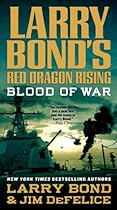
From BooklistThe fourth book in Bond and DeFelices Red Dragon Rising series throws the cast right into the action from the get-go. A few years into the future, China has attacked Vietnam. While the rest of the world watches and waits, an army major inside the war-torn country leads an attack against the Chinese. An American ship off the coast of China waits for a missile strike, and the president of the U.S. contemplates WWIII. Global warming plays a key role in how leaders act and the lengths they will go to keep the status quo. Military fiction fans will follow this shockingly believable scenario eagerly, though those unfamiliar with the series should be warned to start at the beginning; the plot will be largely incomprehensible otherwise. Imagine the four books together as being the longest single Tom Clancy novel ever written, and youll get the idea. --Jeff Ayers The techno-thriller has a new ace and his name is Larry Bond. Tom Clancy, bestselling author of Without RemorseA superb storyteller Larry Bond seems to know everything about warfare, from the grunt in the foxhole to the fighter pilots far above the Earth. The New York Times Book About the AuthorLARRY BOND is the author of numerous New York Times bestselling thrillers, including Vortex, Cauldron, and The Enemy Within. A former Naval Intelligence officer, warfare analyst and anti-submarine technology expert, he makes his home in Springfield, Virginia.JIM DeFELICE is the author of many military based thriller novels and is a frequent collaborator with Stephen Coonts, Larry Bond, and Richard Marcinko, among others. He lives in New York. is selling on worth it Larry Bond's Red Dragon Rising: Blood of War
5 of 5 people found the following review helpful. Enjoyable conclusion to Bond's four-volume series on a China-Vietnam warBy Dan BergerIn this last volume of the Red Dragon Rising series, the handful of Americans who know whats really going on in Vietnam face some fateful choices.The president faces impeachment over what some in Congress think is his desire to go to war with China and defend Vietnam; he knows he must but must do so covertly. Military liaision Zeus Murphy has narrowly escaped with his life after a harrowing mission to Hainan; his superior wants him out of Vietnam but meanwhile he wont go without the Vietnamese woman hes fallen in love with, now under arrest. Commander Dirk Silas of the USS McCampbell has been given the difficult job of shadowing Chinese warships in the South China Sea while simultaneously under orders to avoid; he must play cat and mouse as the Chinese harass Vietnamese and foreign shipping.Meanwhile, scientist Josh MacDonald, an eyewitness to Chinese atrocities against Vietnamese villagers at the invasions outset in the first of the four-book series, is still being stalked by a determined assassin. Fleshing out the action are supporting characters like SEAL Ric Kerfer, Vietnamese Army commander General Minh Trung, and CIA paramilitary Roth Setco.The big question, though, is: China has the overwhelming advantage in force and numbers. How long will it take to overrun Vietnam? How long do the Vietnamese have? And can anything save them?This book continues as the others have strong on the strategizing and weaponry, reasonable in the supply and depiction of action, so-so on the depiction of todays Vietnam, weak on the characterization. Bonds background in Pentagon-level war-gaming provides a dimension not always present in technothrillers a realistic sense of how wars develop, how commanders plot and foresee moves, the ebb and flow of battles and wars, and the many real-life limitations.The war-gamers are represented here by Murphy, whose background in that is whats gotten him detailed to advise the beleaguered Vietnamese Army. In this volume he sees a bold stroke by the Vietnamese underdogs can buy time or even stop the Chinese in their tracks.There are certain limitations in this kind of realistic, what-if, set-in-the-present book. Its tougher to dramatize automated forms of warfare like the missiles and anti-missile systems used by the warships. The human actors make some decisions, give some orders, push some buttons and stand around while bombs go hurtling through the sky. (The era of drones and other robot weapons is going to change the thriller genre, as there are fewer guys with guns and more deskbound geeks in flipflops operating Predators out of an office in Nevada.)Bond is strong on the weaponry and uses that as a form of realistic detail. Now, there are times when you want to know that the Chinese are using a (Im making this up) EK-68A-BL personnel carrier originally built by the Russians, and other times when its just alphanumeric gobbledygook, unnecessarily cluttering up the writing because it doesnt tell you anything important. I understand that with the on-the-ground viewpoint hes providing, that stuff does matter is this a vehicle, say, that the Vietnamese can shoot their AB6-89-43-X (also made up) rocket-propelled grenade at? Or not? This is a realistic book and that stuff, in real life, matters. But lapsing into too much hardware-speak gets a writer onto shaky stylistic grounds. The writer must walk a fine line.Of great value, though, is the big picture and the whole scenario: Changing climate (plausible) causing draught and food riots (plausible) in the worlds most densely populated nation, causing it to eye a fertile neighbor and historic rival next door (quite plausible.)Whats also plausible is how and why the Chinese invasion falters: the army is too hidebound. Its commanders are too nervous to take any chances for good reason, as they face death in their party-dictatorship system if they fail. Its midlevel officers have neither the authority nor experience to improvise in the field. They are slaves to caution. Everyone sugarcoats failures as they report up the line, meaning those at the top dont have accurate information.Bond has also chosen an intriguing scenario overall the U.S. quietly looking for ways to aid those who had been our enemies in a long, difficult and politically damaging war within recent memory, against a nation that could become a far greater threat if it chose an aggressive path. It also offers some benefits from the writer's angle: this is not that much of a high-tech war. It's still being slugged out on the ground by tanks and troops, and whether to take that hill still matters, and makes better reading than pushbutton warfare does.0 of 0 people found the following review helpful. Bond nails the story line to interesting unexpected conclusions. Good yarn!By Bob OurslerSince it had been several months since I read Shock of War, it took me a while to get back into the story and the characters. It took me until Chapt 10 to get all the main characters recalled. The whole story is fast paced, just like the rest of the series. Bond develops his characters by their actions and he keeps the reader guessing what comes next. By the time I got to Chap 30, I could not put the book down for want to see how the story unfolds. The endings of the characters did surprise me. I was not expecting the final scene with Josh, Mara, and Yo. Bond could have continued the story with LCdr Li taking command of a warship in armed conflict. Would have been interesting to see his take on women in command of combatants under fire. More details of burial at sea would have been appropriate. Bond does leave room for a successor tale. The author's note was appropriate but not really necessary. I did pick up on the change of names of the ships, but the Navy does swap ships and assignments/billets. All in all a good yarn that is keeping with modern events.0 of 0 people found the following review helpful. Almost sad that it's over, wanted to keep reading it!By TrustenHaving just finished this series, let me preface my review by simply saying, buy this series!What an amazing series by an equally amazing author. I've been reading Bond's books for well over a decade, maybe two. I highly recommend all of this author's novels to fans of techno-thrillers, military fiction, etc. No spoilers in this review, but here's a very brief synopsis.China invades Vietnam to gain here food resources in a world gripped by climate changes that have left China reeling. The U.S.A. is isolationist, it's president unable to act overtly, racked by internal demons from his time as a POW in Vietnam, uses few advisers and assets to forestall Chinese hegemony over southeast Asia. And that's just the beginning!The series is wonderful. Buy them all and read them on order. You'll love it! You can thank me later for this sage advice! Ha!