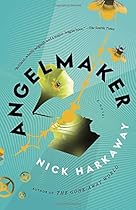
"A head-spinning cliffhanger that reads a bit like Harry Potter for grownups. . . . It would be a shame if no movie were made from this glorious piece of kaleidoscope-fiction." --The Wall Street JournalBrilliant, wholly original, and a major-league hoot. The Seattle TimesNick Harkaway has created a brand new genre: Existential pulp . . . Redolent of comic books and action serials, but there are also serious questions about the nature of existence and personhood being asked. . . . So over the top, it redefines where the top is. io9A big, gleefully absurd, huggable bear of a novel. . . . Harkaways prose is playful and beguiling, with a keen satiric edge. SlateA story of technology and morality. Its a wonderfully strange, rich piece of work extremely entertaining and excitingand has a wonderfully comic aspect to it as well. William GibsonA magnificent, literary, post-pulp triumph. . . . Angelmaker is an entertaining tour-de-force that demands to be adored. The Independent (London)Its hard to put a finger on exactly why Angelmaker is one of the years best books. Know this, though: it is. Tor.comAngelmaker strenuously avoids falling into any usual category of fiction. Part science fiction, part philosophical exploration, part steampunk fantasy and part lovingly realistic description of contemporary London, it pays tribute to Charles Dickens in its quirky names and frequent coincidences, and to pulp fiction in its semi-clad damsels and grisly scenes of torture. It is also mordantly funny. The Columbus Dispatch[Harkaway] manages to write surrealist adventure novels that feel both urgent and relevant. His novels are fun to read without seeming particularly frivolous, and beneath all the derring-do and shenanigans, theres a low thrum of anxiety: everything and everyone you love could disappear at any moment. . . . Angelmaker is a truly impressive achievement. The MillionsA lot of books are fun to read for the plot; a smaller percentage display this artful mastery of the language. And precious few manage to do both. Angelmaker falls into that last category. Wired.comAn ambitious, crowded, restless caper, cleverly told. . . . A solid work of modern fantasy fiction. The Observer (London)Marvelously old-fashioned in the best sense of that word. Its a sprawling, irreverent, blockbuster of a novel, an apocalyptic roller coaster of a book.Open Letters MonthlyA genuine tale of fantastika. . . . And the truth of what we have done, and where we live now, shines through. Strange HorizonsA riotous, wildly inventive mish-mash of genres and seemingly contradictory ideas [Angelmaker] manages the not inconsiderable trick of being both immensely entertaining and curiously heartfelt. The Sydney Morning HeraldA joyful display of reckless, delightful invention, on a par with the rocket-powered novels of Neal Stephenson, if in rather more ironically diffident English form. Ideas come zinging in from all corners, and do so with linguistic verve and tremendous humour. . . . What a splendid ride. The Guardian (London)An intricate and brilliant piece of escapism. . . . Gleefully nostalgic and firmly modern, hand-on-heart and tongue-in-cheek, this is as far as it could be from the wearied tropes that dominate so much of fantasy and SF. Daily Telegraph (London)[The Gone-Away World] was a work of such glorious, exhaustive excess a part of me wondered if Harkaway would actually write again. I am profoundly glad that he has: Angelmaker is every bit as entertaining and imaginative. . . . Effervescent and witty. . . . Harkaway manages the ideal blend of paying homage to a very British sense of decency and fair play, while at the same time idolising the rule-breakers. Stuart Kelly, Scotsman on SundayEndlessly inventive. . . . An absurdist sendup of pulp story tropes and end-of-the-world scenarios. Publishers Weekly (starred review)Harkaways celebrated debut, The Gone-Away World . . . was really just a warm up acta prodigiously talented novelist stretching muscles that few other writers even possessfor this tour de force of Dickensian bravura and genre-bending splendor. . . . This is a marvelous book, both sublimely intricate and compulsively readable. Booklist (starred review)Harkaway keeps us guessing, traveling the edges between fantasy, sci-fi, the detective novel, pomo fiction and a good old-fashioned comedy of the sort that Jerome K. Jerome might have written had he had a ticking thingy instead of a boat as his prop. . . . His tale stands comparison to Haruki Murakamis 1Q84. Kirkus (starred review)About the AuthorNICK HARKAWAY is the author of two novels,The Gone-Away WorldandAngelmaker, and The Blind Giant: Being Human in a Digital World. He is alsoa regular blogger for the Booksellers FutureBook website. From 1999 to 2008, he was a jobbing scriptwriter. During that time he also wrote brochure copy for a company selling bottle-capping machinery, and the website text for an exclusive lingerie boutique. He lives in London with his wife Clare, a human rights lawyer, and his daughter Clemency, an infant.www.nickharkaway.comExcerpt. Reprinted by permission. All rights reserved.I. At seven fifteen a.m., his bedroom slightly colder than the vacuum of space, Joshua Joseph Spork wears a longish leather coat and a pair of his fathers golfing socks. Papa Spork was not a natural golfer. Among other differences, natural golfers do not acquire their socks by hijacking a lorryload destined for St. Andrews. It isnt done. Golf is a religion of patience. Socks come and socks go, and the wise golfer waits, sees the pair he wants, and buys it without fuss. The notion that he might put a Thompson sub-machine gun in the face of the burly Glaswegian driver, and tell him to quit the cab or adorn it . . . well. A man who does that is never going to get his handicap down below the teens. The upside is that Joe doesnt think of these socks as belonging to Papa Spork. Theyre just one of two thousand pairs he inherited when his father passed on to the great bunker in the sky, contents of a lock-up off Brick Lane. He returned as much of the swag as he couldit was a weird, motley collection, very appropriate to Papa Sporks somewhat eccentric life of crimeand found himself left with several suitcases of personal effects, family Bibles and albums, some bits and bobs his father apparently stole from his father, and a few pairs of socks the chairman of St. Andrews suggested he keep as a memento. I appreciate it cant have been easy, doing this, the chairman said over the phone. Old wounds and so on. Really, Im just embarrassed. Good Lord, dont be. Bad enough that the sins of the fathers shall descend and all that, without feeling embarrassed about it. My father was in Bomber Command. Helped plan the firebombing of Dresden. Can you imagine? Pinching socks is rather benign, eh? I suppose so. Dresden was during the war, of course, so I suppose they thought it had to be done. Jolly heroic, no doubt. But Ive seen photographs. Have you? No. Try not to, I should. Theyll stay with you. But if ever you do, for some godforsaken reason, it might make you feel better to be wearing a pair of lurid Argyles. Im putting a few in a parcel. If it will salve your guilt, I shall choose the absolute nastiest ones. Oh, yes, all right. Thank you. I fly myself, you know. Civilian. I used to love it, but recently I cant help but see firebombs falling. So Ive sort of given up. Rather a shame, really. Yes, it is. Theres a pause while the chairman considers the possibility that he may have revealed rather more of himself than he had intended. Right then. Itll be the chartreuse. I quite fancy a pair of those myself, to wear next time I visit the old bugger up at Hawley Churchyard. Look here, you frightful old sod, I shall tell him, where you persuaded yourself it was absolutely vital that we immolate a city full of civilians, other mens fathers restricted themselves to stealing ugly socks. That ought to show him, eh? I suppose so. So on his feet now are the fruits of this curious exchange, and very welcome between his unpedicured soles and the icy floor. The leather coat, meanwhile, is a precaution against attack. He does own a dressing gown, or rather, a toweling bathrobe, but while its more cosy to get into, its also more vulnerable. Joe Spork inhabits a warehouse space above his workshophis late grandfathers workshopin a dingy, silent bit of London down by the river. The march of progress has passed it by because the views are grey and angular and the place smells strongly of riverbank, so the whole enormous building notionally belongs to him, though it is, alas, somewhat entailed to banks and lenders. Mathewthis being the name of his lamentable dadhad a relaxed attitude to paper debt; money was something you could always steal more of.Speaking of debts, he wonders sometimeswhen he contemplates the high days and the dark days of his time as the heir of crimewhether Mathew ever killed anyone. Or, indeed, whether he killed a multitude. Mobsters, after all, are given to arguing with one another in rather bloody ways, and the outcomes of these discussions are often bodies draped like wet cloth over barstools and behind the wheels of cars. Is there a secret graveyard somewhere, or a pig farm, where the consequences of his fathers breezy amorality are left to their final rest? And if there is, what liability does his son inherit on that score? In reality, the ground floor is entirely given over to Joes workshop and saleroom. Its high and mysterious, with things under dust sheets andbest of allwrapped in thick black plastic and taped up in the far corner to treat the woodworm. Of recent days these objects are mostly nothing more than a couple of trestles or benches arranged to look significant when buyers come by, but some are the copper-bottomed real thingtimepieces, music boxes, and best of all: hand-made mechanical automata, painted and carved and cast when a computer was a fellow who could count without reference to his fingers. Its impossible, from within, not to know where the warehouse is. The smell of old London whispers up through the damp boards of the sale room, carrying with it traces of river, silt and mulch, but by some fillip of design and aging wood it never becomes obnoxious. The light from the window slots, high above ground level and glazed with that cross-wired glass for security, falls at the moment on no fewer than five Edinburgh long-case clocks, two pianolas, and one remarkable object which is either a mechanised rocking horse or something more outr for which Joe will have to find a rather racy sort of buyer. These grand prizes are surrounded by lesser ephemera and common-or-garden stock: crank-handle telephones, gramophones and curiosities. And there, on a plinth, is the Death Clock. Its just a piece of Victorian tat, really. A looming skeleton in a cowl drives a chariot from right to left, so thatto the western European observer, used to reading from left to righthe is coming to meet us. He has his scythe slung conveniently across his back for easy reaping, and a scrawny steed with an evil expression pulls the thing onward, ever onward. The facing wheel is a black clock with very slender bone hands. It has no chime; the message is perhaps that time passes without punctuation, but passes all the same. Joes grandfather, in his will, commended it to his heir for special considerationthe mechanism is very clever, motivated by atmospheric fluctuationbut the infant Joe was petrified of it, and the adolescent resented its immutable, morbid promise. Even nowparticularly now, when thirty years of age is visible in his rear-view mirror and forty glowers at him from down the road ahead, now that his skin heals a little more slowly than it used to from solder burn and nicks and pinks, and his stomach is less a washboard and more a comfy if solid benchJoe avoids looking at it. The Death Clock also guards his only shameful secret, a minor, practical concession to the past and the financial necessities. In the deepest shadows of the warehouse, next to the leaky part of the wall and covered in a grimy dustsheet, are six old slot machinesgenuine one-armed banditswhich he is refurbishing for an old acquaintance named Jorge. Jorge (Yooorrr-geh! With passion like Pasternak! he tells new acquaintances) runs a number of low dives which feature gambling and other vices as their main attractions, and Joes job is to maintain these traditional machineswhich now dispense tokens for high-value amounts and intimate services rather than mere penniesand to bugger them systematically so that they pay out on rare occasions or according to Jorges personal instruction. The price of continuity in the clockworking business is minor compromise. The floor abovethe living area, where Joe has a bed and some old wooden wardrobes big enough to conceal a battleshipis a beautiful space. It has broad, arched windows and mellowed red-brick walls which look out onto the river on one side, and on the other an urban landscape of stores and markets, depots and back offices, lock-ups, car dealerships, Customs pounds, and one vile square of green-grey grass which is protected by some indelible ordinance and thus must be allowed to fester where it lies. All very fine, but the warehouse has recently acquired one serious irritant: a cat. At some time, one mooring two hundred yards up was allowed to go to a houseboat, on which lives a very sweet, very poor family called Watson. Griff and Abbie are a brace of mildly paranoid anarchists, deeply allergic to paperwork and employment on conscientious grounds. Theres a curious courage to them both: they believe in a political reality which is utterly terrifying, and theyre fighting it. Joe is never sure whether theyre mad or just alarmingly and uncompromisingly incapable of self-delusion. In any case, he gives any spare clockwork toys he has to the Watsons, and eats dinner with them once in a while to make sure theyre still alive. They in their turn share with him vegetables from their allotment and keep an eye on the warehouse if he goes away for the weekend. The cat (Joe thinks of it as the Parasite) adopted them some months ago and now rules the houseboat by a combination of adept political and emotional pressure brought to bear through the delighted Watson children and a psychotic approach to the rodent population, which earns the approval of Mr. and Mrs. W. Sadly, the Parasite has identified the warehouse as its next home, if once it can destroy or evict the present owner, of whom it does not approve. Joe peers into the piece of burnished brass he uses as a shaving mirror. He found it here when he took possession, a riveted panel from something bigger, and he likes the warmth of it. Glass mirrors are green, and make your image look sick and sad. He doesnt want to be the person he sees reflected in a glass mirror. Instead, heres this warm, genial bloke, a little unkempt, butif not wealthyat least healthy and fairly wise. Joe is a big man, with wide shoulders and hips. His bones are heavy. He has a strong face, and his skull is proud beneath the skin. Passably handsome, perhaps, but not delicate. Unlike Papa Spork, who had his fathers genes, and looked like a flamenco dancer, Joe is most unfairly designed by nature to resemble a guy who works the door at the rougher kind of bar. He gets it from his mothers side: Harriet Spork is a narrow creature, but that owes more to religion and meals high in fibre than it does to genetics. Her bones are the bones of a Cumbrian meat-packer and his Dorset yeoman wife. Nature intended in her design a hearty life of toil, open fires and plump old age attended by a brood of sun-touched brats. That she chose instead to be a singer and more latterly a nun is evidence of a certain submerged cussedness, or possibly a consequence of the strange upheavals of the twentieth century, which made rural motherhood look, at least for a while, like an admission of defeat. From somewhere in the warehouse, theres a curiously suffused silence. A hunting silence: the Parasite, having declared war almost immediately upon making his acquaintance, enters each morning via the window that Joe props open to stop the place getting stuffy when the central heating comes on, and ascends to balance on the white, moulded frame around the kitchen door. When he passes underneath, it drops onto his shoulders, extends its claws, and slides down his back in an attempt to peel him like an apple. The leather jacket and, alas, the skin beneathbecause the first time this happened he was wearing only a pajama shirtcarry the scars.Today, tiring of a.m. guerilla warand sensitive to the possibility that while he is presently single, he may one day bring an actual woman to this place, and she may wish not to be scalped by an irate feline when she sashays off to make tea, perhaps with one of his shirts thrown around her shoulders and the hem brushing the tops of her elegant legs and revealing the narrowest sliver of buttockJoe has chosen to escalate the situation. Late last night, he applied a thin layer of Vaseline to the coping. He tries not to reflect on the nature of a life whose high point is an adversarial relationship with an entity possessing the same approximate reasoning and emotional alertness as a milk bottle. Ah. That whisper is a silken tail brushing the mug tree with its friendly, mismatched china. That creak means the floorboard by the wall, that pitter-patter is the animal jumping from the dresser . . . and that remarkable, outraged sound must be the noise it makes bouncing off the far wall after sliding all along the coping, followed by . . . yes. An undignified thump as it hits the floor. Joe wanders into his kitchen. The Parasite stares at him from the corner, eyes spilling over with mutiny and hate. Primate, Joe tells it, waggling his hands. Tool user. Opposable thumbs. The Parasite glowers, and stalks out. Having thus inaugurated Victory Over The Cat Day, it is in the nature of his world that Joe Spork should immediately be overtaken on the ladder of mammalian supremacy by a dog. how can i download pdf books for free Angelmaker (Vintage Contemporaries)
11 of 11 people found the following review helpful. A quirky romp that offers more than just funBy A. BudnerAn inventive intricate bit of literary stew. Harkaway's novel reads like a comic spy thriller, a tour through Peter Ackroyd's and Charles Dickens's London replete with honorable thieves and evil government operatives, a steampunk comic without the pictures, and a P.G. Woodehouse romp all nicely marinated and cooked to tender perfection. Can our hapless hero, Joshua Joseph Spork, a meek and law abiding clockmaker, manage to avert the end of the world? Or will he, and everyone else, meet an untimely end, despite the assistance of a girl with moxie, a vicious if blind elderly pug, a nonagenarian female super spy, the world's craftiest lawyer, his father's tommy gun and the best the London underworld has to offer?Beneath the frenetic action, "Angelmaker" is about Joe's coming into himself and coming to terms with his family's history. Even while maintaining a light and farcical tone, Joe's emotional life and growth are affecting and along with Harkaway's interest in philosophical questions give the book greater resonance than might be expected from the jacket blurbs and a plot summary. The central emotional journey is framed with appealing considerations of such heavyweight questions as the nature of free will, the knowability and implications of absolute truth. Not to mention considerations of faith and morality. Thankfully Harkaway doesn't overplay his hand and manages to integrate these considerations into the plot and character development with appealing breeziness.The only significant missteps in the book are unfortunately centered on Joe's love interest, Polly. Oftern she is a woman to be reckoned with and her appeal palpable. At other times, however, she is reduced to an adolescent male fantasy figure. Her argument on why she and Joe should have sex is a brilliant piece of logic that, while funny, reads like something every teenage boy wishes had happened to him. At other points she fluctuates wildly between bracing competence and a caricature of a dumb moll. Really, it's just too much. Yes, female characters can like sex, but it makes her into a figure of fun instead of a real person that Joe, a fully realized and emotionally expansive figure, would come to love.While it is a minor note, as with many novels by talented writers, the editors seem to have backed away from the last little bit of tightening that would have changed little, but made this an even more approachable and tightly crafted novel. I realize it's difficult to quash verbally inventive writing, but there were points where bit jokes were left in when they should have been cut and other points where a touch of extra clarification and emphasis would have tied together plot points in a way that could have helped the story pack an even harder punch.Minor flaws aside, this is grand fun and I look forward to Harkaway's next outing and in the meantime, I'm planning to read his first book, "The Gone-Away World" though it's too bad he hasn't written more for me to delve into -- yet.11 of 12 people found the following review helpful. A DisappointmentBy ShambalagalaThe first third to half of the book I found very confusing. I didn't know what these unique pieces were about - whether they were part of one device or two or what. I suspect the story was told in not-very-obvious flashbacks at times, so the order of events wasn't that clear, and I kept going back to try to figure out what happened when. It was entertaining at this point, though, even though I really wished I knew what was going on. There's a lighthearted humor here.Then about two-thirds of the way through there's this long, brutal torture session, which really turned me off. After that, it became a simple revenge story with little cleverness or surprises. Just imagine any big action movie ending and you can skip the last third of the book.Most of the characters were very one-dimensional - props for the main 2-3 characters. The good girlfriend, the evil bad guy who wants to destroy the world. He's bad because he's evil, you know. Oh sure there's some weak justification for it, but wanting to destroy the world is so cliche, so weak. A great nemesis can make a book but this did not have one.I don't know if George R.R. Martin spoiled me, but every single thing in the book is relevant, is necessary, is brought back to be part of the revenge at the end. It's all so neat, so tidy. Nothing told in the book is tangential to the story or used simply for character development.And most of all, the machine in this book has such immense potential for stories, and it was left completely ignored. Why think up a device like this only to go into the experience of it so vaguely, when you could literally generate thousands of interesting consequences. Show us why this is such a powerful thing, have it affect the main characters in a meaningful way. A week under its effects could be an mesmerizing story in its own right. Such a missed opportunity.0 of 0 people found the following review helpful. Enjoy the rideBy Rachael KleinAn amusing, tongue-in-cheek, entertaining read, with well-written and colorful characters, a swinging plot, and a lovable protagonist. We start the book with a line indicative of Mr. Harkaway's wry + wit style getting our introduction to Joe Spork who wakes up in his bedroom which is "slightly colder than the vacuum of space" A full but well-allocated chapter is spent introducing us to Joe Spork and laying some groundwork. No punchline yet to throw us into the mystery as is the case with 99% of mysteries, so some patience from an over-eager mystery-lover is required. Mr. Harkaway does an impressive job of including the reader inside his jokes and feeling part of the club which has formed and bonded to save the world. Not sure what genre it goes in, but a fun time nonetheless. I was sad to finish it but grateful I had picked it up.