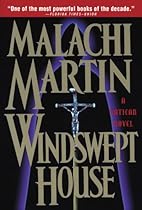
From Publishers WeeklyA Black Mass in the Vatican in 1963 gets Malachi's first novel since Vatican (1985) off to a wicked start. A potentially gripping conflict between two American brothers?one a priest, one a lawyer, both heirs to a fortune and to the family manse of Windswept House?follows. But as Martin, a former Jesuit and veteran Church commentator, develops his complex plot, he begins to dwell to a fault upon the themes he's explored in numerous books, most recently The Keys of This Blood, 1991. Martin's concern is what he sees as the erosion of the Church's moral authority, both from within and without. Here, a Slavic pope who's obviously John Paul II is being maneuvered into approving the Resignation Protocol, which, if enacted, will force him to resign in the name of Church unity. Martin attributes this erosion to a global conspiracy among world powers both East and West, fueled by Satanic influence and by the failure of John XXIII to act upon the Third Prophecy of the Fatima Letter in 1960. The narrative is richly detailed with Church lore, but the sermonizing is incessant, with dialogue often sounding more like editorial commentary than speech. Many think of the current pope as theologically conservative, but Martin, through one of the brothers who have been caught up in the struggle, takes him roundly to task: "You have abandoned your seminarians to heretical teachers... your nuns to a destroying wave of secularizing feminists," and so on. What could have been a smart and shocking thriller winds up instead as an onslaught of ecclesiastical facts and religious opinions occasionally interrupted by plot. The wind that blows through this rambling shack of a novel is, ultimately, angry and hot. Major ad/promo; author tour. Copyright 1996 Reed Business Information, Inc.From Kirkus sThe author of Vatican (1986), among others, returns with a mammoth meditation on the troubled state of today's Catholic Church. So troubled, as one of the characters reports to the ``slavic Pope'' who is the central figure here, that ``it's going down.'' In his opening scenes, surprising for this measured writer, Martin portrays an animal sacrifice straight out of Stephen King, and Lucifer's plan is unveiled: to penetrate the Church hierarchy and eventually the Holy See itself with corrupt priests. They are bent on merging with economic and ethical universalists in the public arena, but their true agenda is the ascension of Satan and the annihilation of humankind. A young American priest, Christian Gladstone, from a place of peace called Windswept House, attempts to reverse these trends in his audiences with the slavic Pope; his twin brother, a lawyer, is embroiled in the impending new world order. They are light and dark, but, curiously, the slavic Pope is gray. He as much as anyone stood against Stalinist forces in Eastern Europe, but at a cost to the private message of faith and redemption the Church always has symbolized. But, while he himself has secularized the Church, his personal faith is deeply traditional. He seeks a revelation from an aged nun who participated in the Marian manifestation at Fatima. Can she tell this weary old man when Jesus will return? Does he have the strength for one last battle, as Lucifer stands poised to become Pope? Slowly, indeed, Martin's passions--and his agony over the dire straits of his faith--build into a deeply felt moral crisis. Martin is a close associate with Pope John XXIII, and his knowledge of Vatican politics is extraordinary. He pauses just short of the Apocalypse, but should find readers among Catholics and many evangelicals. Too slow-moving, and too specialized, for everyone else. (Author tour; radio satellite tour) -- Copyright 1996, Kirkus Associates, LP. All rights reserved. "He fetches Christianity onto the stage of history.Martin enjoys indulging his considerable skills, much to the pleasure of the reader."--The New York Times"...a meditation on the troubled state of today's Catholic Church... [Martin's] knowledge of Vatican politics is extraordinary." --Kirkus sFrom the Hardcover edition. can i get books for free Windswept House: A Vatican Novel
78 of 82 people found the following review helpful. Only Time Will Tell.By BDHMalachi Martin was a great man. It's too bad he's no longer with us, especially since he can no longer go forthright in his quest to expose what is so wrong in our great Catholic Church and Vatican upper echelon. Was his death an accident or an outright slaying? I wish someone knew the truth, and also had the proof and courage to speak up. Whether this book is of fact or fiction, it is a portrayal of life, morality, and the ultimate test of faith and honorability. Maybe somewhere, someday, there will be (or already is) another great man such as Martin, whose love and courage will help to complete the final pages. As with this story, and the evil and hatred portrayed in it, the horrible molestations and sacrilegious rituals, only time will tell the final outcome and the truth. This was a fascinating book.13 of 14 people found the following review helpful. "Faction" is a good name for itBy A CustomerThis is not the best written story I have ever read, but certainly one of the more interesting. It is an accurate description of the current state of the Roman Catholic Church -- Protestantized and overrun by secular humanists, it has no identity with anything in its history before 1965.While the reasons for this change can be construed as belonging solely to the realm of fiction, many of the events are allusions to events that have really occurred and can be verified with a little effort (e.g., certain ritualistic slayings of priests in the midwest). The motivations and attitutes of the principle hierarchical protagonists are nothing short of fact especially for those of us who at one time lived under the watchful eye of the "Cardinal of Century City" in a diocese which used to be one of the largest, most Catholic areas of the country (anyone can figure out which deceased U.S. Cardinal he represents with some little effort) whose orchestrations and two-faced dealings are only beginning to come to light today, but are quickly buried by the NCCB.If you're confused why the Church has changed so much, how it can go from the Church of Christ which concentrated on pleasing the Lord above all, to one of the main proponents of Masonic secular humanism which concentrates only on pleasing man and catering to his (or her) social whims in only 30 or so years, this is one not-so-pleasant theory. How much is true, I am afraid to guess, but I will say this book accurately reflects the current condition of the Roman Catholic Church in an artistic manner.25 of 28 people found the following review helpful. a dash of cold waterBy Sheena Leader Of the FuzzheadsYou may not like what you read here, but it explains much of the apparent incompetence and stupidity in the discipline of the present day Catholic Church. The ordinary reader will never know for sure if the enthronement of Lucifer really took place in 1963 in the Vatican. Fr. Martin, however, clearly believed that it did. (He was a committed supernaturalist and Christian, and his views were not at all out of place prior to Vatican II and the invasion of the Church by modernism.) As his operating hypothesis for the loss of supernatural grace in the modern church and world, it does hold water. But it will be rejected by materialists. My own experience with the occult, prior to my conversion to Christianity, agrees with Fr. Martin's worldview and theology. His absolute devotion to Christ is radiantly apparent to me. But his uncompromising claims of Masonic and Luciferian infiltration into the Church are bound to infuriate those who are hoping to stick their heads in the sand and wait for the present turmoil to blow over. It won't.