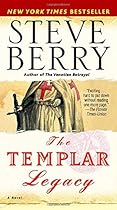
From Publishers WeeklyBerry goes gnostic in this well-tooled Da Vinci Code-knockoff, his fourth novel (The Romanov Prophecy). Ex-U.S. Justice Department agent Cotton Malone is intrigued when he sees a purse snatcher fling himself from a Copenhagen tower to avoid capture, slitting his own throat on the way down for good measure. Further snooping introduces him to the medieval religious order of the Knights Templar and the fervid subculture searching for the Great Devise, an ancient Templar archive that supposedly disproves the Resurrection and demolishes traditional Christian dogma. The trail leads to a French village replete with arcane clues to the archive's whereabouts, and to an oddball cast of scholar-sleuths, including Cassiopeia Vitt, a rich Muslim woman whose special-ops chops rival Malone's. Malone and company puzzle over the usual Code-inspired anagrams, dead language inscriptions and art symbolism, debate inconsistencies in the Gospels and regale each other with Templar lore, periodically interrupting their colloquia for running gun battles with latter-day Templar Master Raymond de Roquefort and his pistol-packing monks. The novel's overcomplicated conspiracies and esoteric brainteasers can get tedious, and the various religious motivations make little sense. (Thankfully, the author soft-pedals the genre's anti-Catholicism.) But lively characters and action set pieces make this a more readable, if no more plausible, version of the typical gnostic occult thriller. (Feb.) Copyright Reed Business Information, a division of Reed Elsevier Inc. All rights reserved.From BooklistThe Knights Templar, a small monastic military order formed in the early 1100s to protect travelers to the Holy Land, eventually grew and became wealthy beyond imagination. In 1307, the French king, feeling jealous and greedy, killed off the Templars, and by 1311, the last master, Jacques de Molay, was burned at the stake. The whereabouts of the Templars' treasure--and their secrets--have been the subject of legend ever since. Now, a new thriller trieas to follow in the steps of The Da Vinci Code.There's a secret about early Christianity at the core of Berry's Templar Legacy, but he dispenses the clues too slowly. The cat-and-mouse game between Cotton Malone, a former Justice Department agent, and a modern-day order of Knights Templar is weighed down with too much confusing backstory about the Templars' connection to Rennes-le-Chateau and the mystery that surrounds it. (The real-life town plays a part in The Da Vinci Code as well.) Like Dan Brown, Berry draws on the seminal nonfiction work Holy Blood, Holy Grail for many of his themes. After nearly grinding to a halt through all the premise building, the novel finally gathers steam in the last 100 pages or so, concluding with a revelation that seems refreshingly clear after the many convoluted twists that precede it. Until the next Dan Brown opus is released, this should hold devotees. Ilene CooperCopyright American Library Association. All rights reserved Praise for Steve BerryThe Amber RoomSexy, illuminating . . . my kind of thriller.Dan Brown, author of The Da Vinci CodeMagnificently engrossing, with wonderful characters and a plot that speeds, twists, and turns. Pure intrigue, pure fun.Clive Cussler, author of Sacred Stone The Romanov ProphecyPerfect for thriller fans and history buffs alike. Fabulous plot twists.David Morrell, author of The ProtectorCompelling . . . adventure-filled . . . a fast-moving, globe-hopping tale of long-lost treasure and shadowy bad guys.San Francisco ChronicleThe Third SecretControversial, shocking, explosive . . . rich in a wealth of Vatican insider knowledge and two thousand years of Virgin Mary visitations. The Third Secret will change our view of the relationship between religion and wisdom.Katherine Neville, author of The EightFrom the Hardcover edition. who is the best book author The Templar Legacy: A Novel (Cotton Malone)
4 of 4 people found the following review helpful. Boring....By AndronikeThe story was potentially a good one, but it turned out to be so boring that I had to force myself to finish it. Apparently the author Steve Berryimproves in his later novels. Also the dialog was often inane, especially in Stephanie's case. Hard to believe this book was a best seller.But the author deserves credit for using the Templar history and I learned a lot by reading this book.0 of 0 people found the following review helpful. A good book.By J. TantI bought this on a whim - I've heard some good things about Berry and I have to say, his writing style did not disappoint. And yes, it's entirely fair to say this is, er, "inspired" by Dan Brown.But I think it goes a little far to call it an outright knockoff. Cotton Malone makes for an intriguing protagonist, and the story moves along within his characterization. By that I mean I don't have to suspend a whole lot of disbelief to accept startling leaps of insight and intuition from the characters.The story itself is, well, I'm not sure it matters. I mean, the plot for thrillers doesn't have to be documentary-quality. Suffice it to say that facts cited aren't inaccurate, the story itself is plausible and works with its own internal logic, and it's not something that makes me roll my eyes. There are certain sequences in the book that had me turning pages...well, pressing the Next Page button on my Kindle anyway.In short, it's an enjoyable read...a good overview of history to make it accessible to the interested lay reader, enough facts to keep it interesting for those who know more about the history in question, and Berry does interesting things with it all to turn it into a work of fiction. It's a good book.7 of 8 people found the following review helpful. convoluted, poorly wirttenBy David Ga terrible imitation Da Vinci code (by dan brown). Convoluted plot with clues that only make sense if you force them after the fact.Somehow the previous leader of the Templars could predict the future actions of people and made appropriate plans. a needlessly convoluted past about previous people who had found and decoded the clues to Templar treasure. a treasure Templer secret that made little sense as ammunition to blackmail catholic popes. other gospels had come and gone and been decreed heresy the Templers had no more credibility than any other prophets spitting into the wind.character personality are not credible. motivations are ridiculous. action illogical. solutions are found by leaps of logic that strain readers credibilityI speed read just to see if dramatic conclusion woudl be interesting. don't bother